
Software code auditing helps identify hidden issues that affect performance, security, and scalability before they impact users. It gives teams a clear picture of system reliability and highlights risks that often remain unnoticed during regular development. In 2026, code auditing is a core engineering practice for products that are expected to scale and operate under real user load.
If your system is growing or preparing for expansion, working with an independent code audit company helps detect architectural gaps, security vulnerabilities, and performance bottlenecks early. This approach reduces rework, improves stability, and protects your product from critical failures after release.
This guide explains how code auditing works and how to apply it effectively.
What Is Software Code Auditing?
A software code audit provides a systematic examination of your source code that looks at the code’s overall quality, security, and ability to be maintained in the long term.
A software code audit consists of an examination of the code structure, verification of dependencies, discovery of vulnerabilities within the code, and review of architectural decisions made during the development of the application. Ultimately, the goal is to determine if the application is capable of supporting scaling, integrations with other applications, and updating continuously without significant issues.
Software code auditing evaluates all aspects of an application, while debugging only focuses on resolving issues that are visible to the user. The software code audit evaluates how the elements of the application interact and if the functionality of the application is reliable regardless of the conditions in which the application is being used.
The OWASP (Open Web Application Security Project) recommendation for reducing application vulnerabilities and avoiding security risks is to conduct secure code reviews.
Why Code Auditing Matters
The way that you audit your code can greatly affect the overall performance of your product and how well your business ultimately performs.
If you have bad quality code then it can lead to more unstable releases, slower response times and much higher costs of maintenance. Many times, when you see problems like these it’s because of when you scale systems or when you implement new features without first auditing the existing codebase.
It’s just as important to understand that your code creates security risks as well. Vulnerabilities in code can cause exposure of sensitive information and create issues with regulatory compliance. Conducting regular audits will allow for the early identification of these vulnerabilities, which will reduce the risk of being exposed to those vulnerabilities over time.
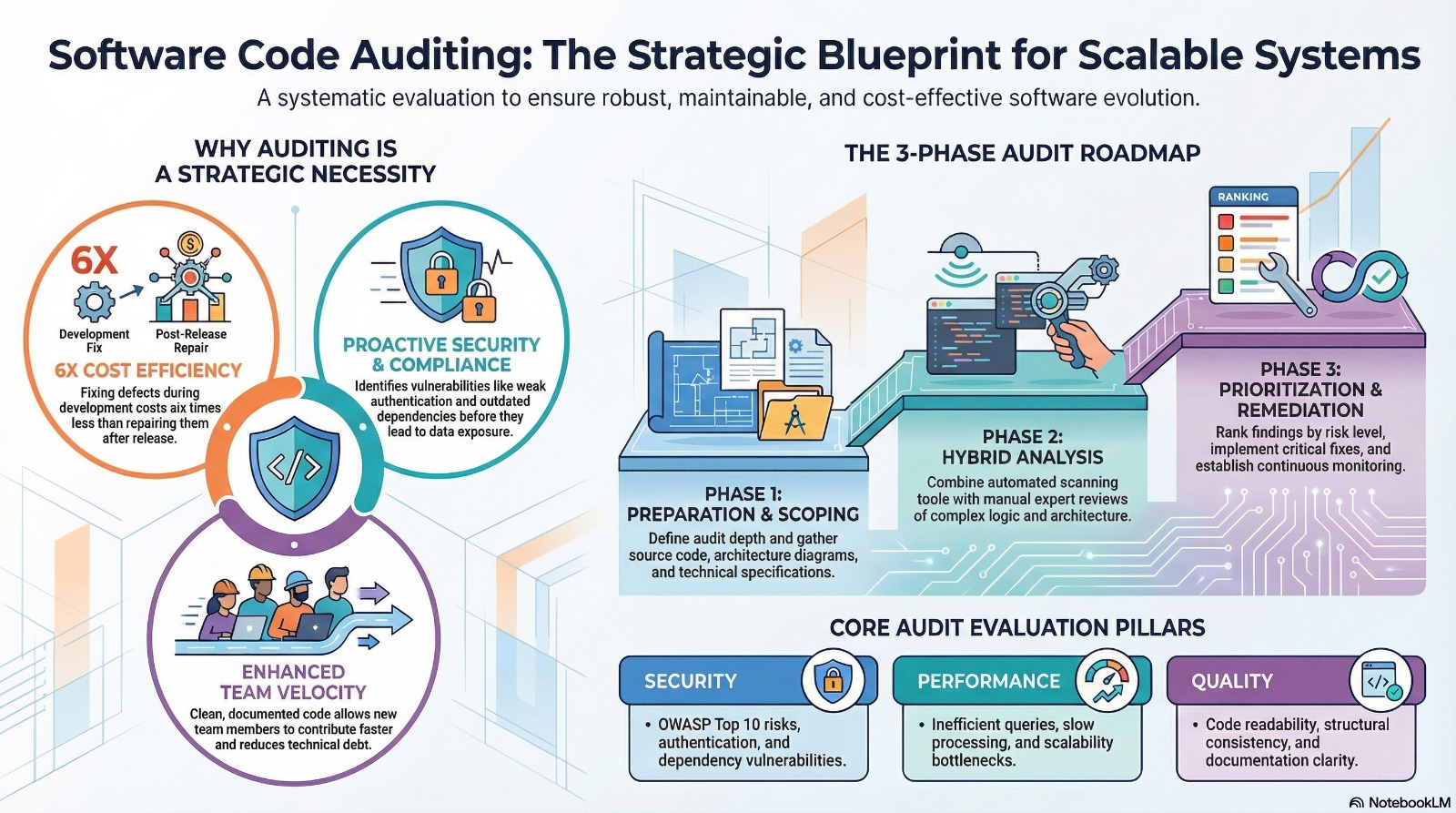
According to some research done by IBM, it can cost as much as six times more to correct defects after release than it would to correct the defect during development. Because of this, conducting code audits is considered to be a valuable method for controlling the long-term costs associated with software development and product operations.
Another advantage of conducting code audits is improving development efficiency. Clean, structured code reduces the amount of time that it takes new team members to get up to speed with the application and will also help your team deliver updates faster.
When Should You Perform a Code Audit?
When performed during appointed development cycle phases, code audits are an excellent way to maximise the value of code auditing.
One major point of value is pre-scaling or pre-traffic growth. Increased traffic makes performance problems and architectural limitations clearer, so conducting a code audit at this point can identify any potential risks to existing users before they become problems.
Another time for conducting an audit is before a significant release. A code audit performed just prior to releasing a version will allow for the assessment of integration with any newly created features, as well as for the identification of any deployment regressions.
A code audit will also provide value when a team makes a change in personnel. A code audit will allow new developers to become acquainted with the project codebase and to determine what areas of the project may require improvement.
What Does a Code Audit Include?
A thorough audit will assess multiple aspects including:
Code Quality – The audit will analyse the readability, structure and consistency of the code. A structured code is less prone to errors and is easier to maintain.
Security – The audit will identify vulnerabilities in the system such as improper input handling, weak authentication, and out-of-date dependencies. The OWASP Top 10 is a common benchmark for identifying security risks.
Performance – The audit will identify inefficient operations, slow queries, and unnecessary processing, all of which can impact the end-user experience as the application continues to grow.
Architecture – The audit will review the architecture of the application to determine if it is able to scale and integrate with other systems. Poorly designed architectures are often a constraint to future enhancements.
Documentation – The audit will review documentation to ensure that technical knowledge is comprehensible and readily accessible, otherwise it becomes difficult to maintain the system.
How to Perform a Code Audit Step by Step
Establishing a structured process produces consistent results. The first step in the audit process is to define the scope of the audit – system-wide or narrow focus, whichever is appropriate based upon risk level.
Collect all relevant materials (i.e., source code, specifications, architecture diagrams, etc.) to provide the audit with full context prior to beginning any investigation.
Automated tools should then be incorporated to assist in identifying potential issues by searching for common vulnerabilities and structural problems quickly. Static analysis tools can be particularly helpful as they can identify vulnerabilities and structural issues in your systems quickly.
The next step in the audit process is to review manually. Experienced engineers will review the architecture, design, and components to identify any potential issues that may not have been detected through automated tools.
All findings will subsequently be documented and prioritized in terms of risk (i.e.; security, performance, etc.) so the highest risks can be addressed first.
Next, improvements will be made based upon these findings and tested for their effectiveness. Continued monitoring will be required to ensure continued stability over time.
Common Issues Found During Code Audits
As part of application code audits, developers frequently recognize systemic issues within their applications that can adversely impact the reliability of their systems.
Inconsistent coding practices can lead to greater challenges when attempting to maintain an application and create opportunities for new bugs.
Limited error handling capabilities create unpredictable outcomes and challenges when debugging.
Common security vulnerabilities are caused by poor validation, outdated libraries, etc…
Performance bottlenecks can also occur in inefficient queries or unoptimized coding logic in addition to the above examples, but these issues become much more serious as an application grows.
Tools Used in Code Auditing
Combining expert analysis with automated procedures is how we perform Modern Code Auditing.
A code quality problem or vulnerability is identified through the use of Static Analysis Tools (such as SonarQube and ESLint).
Because Dynamic Analysis Tools validate runtime behaviours and provide insight into performance issues, they are very useful too.
Third-Party Libraries can potentially contain vulnerabilities. Therefore, we use dependency scanners (e.g., Snyk) to find these vulnerabilities.
However, Manual Review and Human Knowledge still play a large part in evaluating how well the architectural design meets its intended purpose and how well complex logic is implemented.
Challenges in Code Auditing
Time, experience, and proper method are all necessary for properly conducting a code audit.
If a codebase is not well organized, it’s hard to perform an audit on the overall codebase. Important issues will likely be found only if the codebase is structured properly.
If documentation is not prepared, it slows down the process and increases the risk of confusion.
Due to time constraints, an audit may not review the full scope of an application; thus, teams will prioritize based on what they believe to be “critical” items. Thus, some underlying issues will go undetected during the audit.
Poor communication between groups may delay the implementation of needed changes.
How to Make Code Auditing Effective
In order for effective auditing to take place, consistent priorities and an adequate definition of intended goals must be established. Find areas that have an impact on system security and performance. Utilize a mixture of automated and manual tools to conduct thorough reviews.
Conduct audits on a regular basis. By continually auditing, you will reduce the amount of technical debt that accumulates. Use consistent communication methods between departments to maximize the use of results and ultimately achieve effective improvement initiatives.
Conclusion
For a reliable and lasting product, it is crucial to perform software code evaluations. These evaluations help find any potential risk at an early stage, and enhance performance and long-term savings. Companies that have incorporated code evaluations as part of their process have been able to maintain good quality in their codebase and prevent major crashes from occurring.
Using an organized methodology with good tools and engineering ability will provide measurable benefits from code evaluations.





Leave a Comment